
How Effective Leadership Shapes Your Process Safety
Date Published:
Reviewed by:
Dr Mark Bunch
TL;DR
Process safety is a leadership responsibility, not just a technical function. Sustained executive commitment via governance, verification, and long-term cultural reinforcement is a decisive factor in preventing catastrophic incidents.
Should you reconsider your PSM strategy?
If you answered “no” to any of the following questions, you may want to consider creating a process safety management system:
Do you have clear visibility of your organisation’s critical hazards and the safeguards in place to prevent a major incident?
Do you receive regular, meaningful assurance that your safeguards are effective and being maintained?
Do you know how process safety performance is measured in your business, and are you confident the metrics reflect real risk, not just compliance?
Do you actively demonstrate leadership in safety by engaging with frontline teams, or is process safety delegated entirely to technical staff?
Do you have a long-term strategy to sustain process safety culture, even when financial pressures or production demands increase?
Why is Leadership the Cornerstone of Process Safety Performance?
For senior leaders, process safety management (PSM) like, sales, marketing and operations must be central to your business strategy. This is because the effectiveness of a PSM strategy is determined by the decisions and priorities by those at the very top of an organisation.
The UK Health and Safety Executive (HSE) has found that strong leadership is the main factor affecting safety outcomes in the process industries. IChemE’s Safety Centre research reinforces this, showing that visible, engaged leadership correlates with lower rates of major incidents.
Under the COMAH 2015 regulations, senior leaders at major hazard sites carry direct accountability for demonstrating that all necessary measures have been taken to prevent major accidents — making process safety leadership a regulatory duty, not just best practice.
Workplace Example
The BP Texas City refinery disaster. Before the explosion, maintenance budgets were slashed, training programmes were cut, and staff numbers were dropped to save money. These short-term savings resulted in loss of life, financial setbacks, and lasting harm to the company’s reputation. The Baker Panel noted that the high turnover rate of business unit leaders and the focus on production were key factors in the explosion.
As a leader, you need to set the strategic direction, divide resources, and create conditions that value and prioritise safety.
Process Safety Insight
Effective leadership in process safety requires more than control, it requires ownership. Leaders must actively engage with PSM, ensuring it is embedded in every decision-making process.
In this blog, we discuss what business leaders can do to ensure that process safety management becomes a living entity engrained into a business rather than a ‘one-and-done’ tick-box exercise that quickly gets forgotten about.
Pivot From Compliance to Commitment Through Company Culture
Organisational culture results from values, attitudes, competencies, and behaviours that determine how we manage safety. While culture itself cannot be changed directly, behaviour can.
The UK Health and Safety Executive defines culture as the product of values, attitudes, competencies, and behaviours that determine how health and safety are managed. But, you cannot change culture directly as attitudes shape it, and behaviour in turn shapes those attitudes.
Process Safety Insight
A more succinct definition is ‘How the organisation behaves when no one is watching’.
As a leader, you can influence culture by influencing behaviour. This means that you will need to set clear expectations, model safe practices, provide the right systems and processes, and consistently reinforce those behaviours.
Over time, consistent behaviour changes attitudes, and attitudes reshape culture.
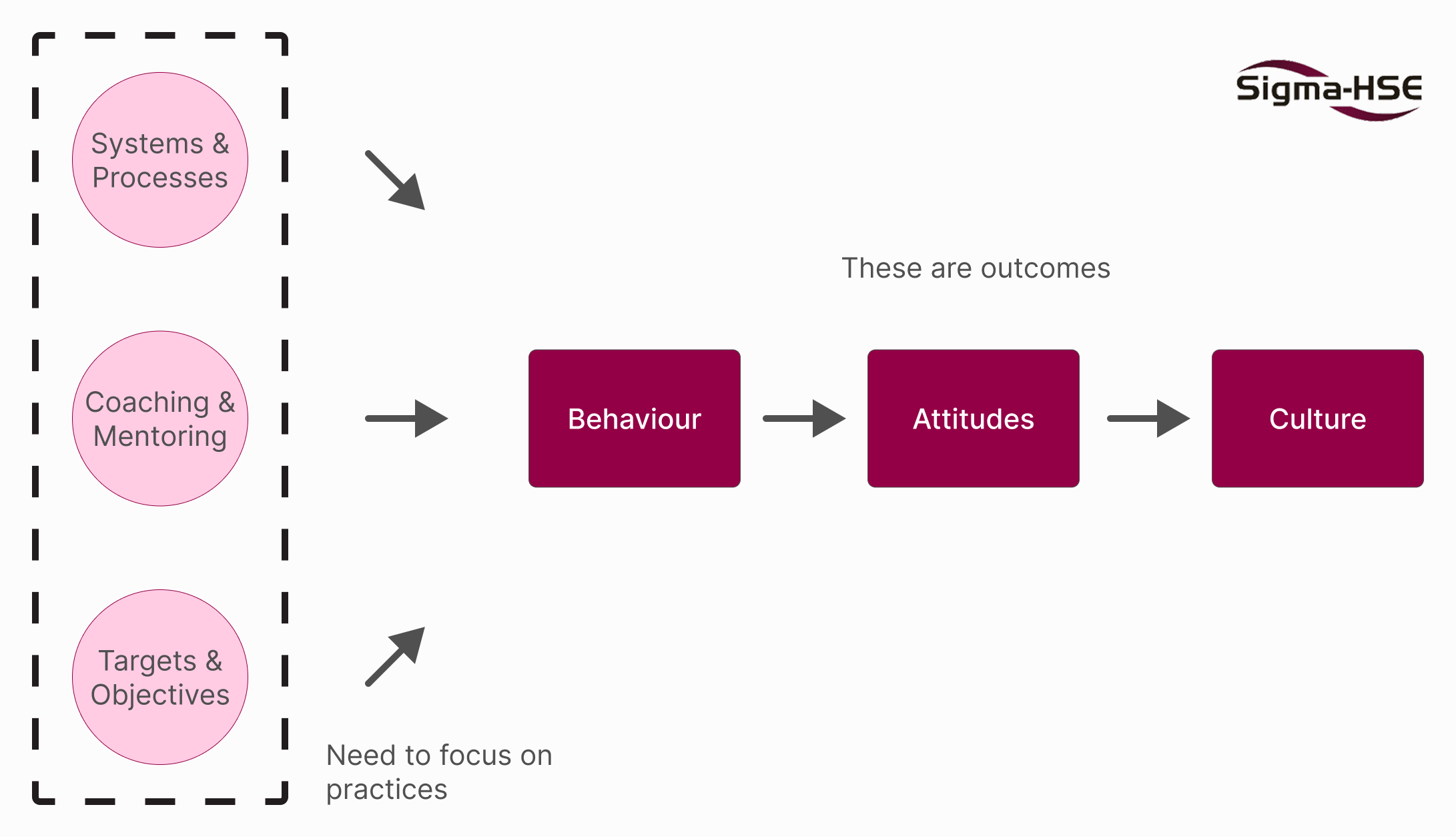
Changing culture is neither quick nor simple. It requires patience, persistence, and clarity of purpose. Leaders need to know that a compliance-driven culture, which aims to avoid penalties, is not the same as a commitment-driven culture. The latter aims to protect people and operations because it’s the right thing to do. You can read more about creating a just culture here.
Process Safety Insight
When leaders show they won’t compromise on safety, even under pressure, that message spreads through the organisation.
Understanding Hazards and Consequences From the Top
Leadership affects process safety by making sure everyone in the organisation knows the hazards and their possible consequences.
The challenge for management is to keep process risk visible on the corporate agenda. This is tough when operational pressures push for short-term gains.
Process Safety Warning
Identifying hazards is crucial, but safety performance depends on the attention, resources, and governance that the leadership provides.
For organisations that need independent, structured oversight to verify that safeguards are working as intended, a Comprehensive Safety Review provides a qualified competent person to carry out exactly those inspections, free from internal pressures or production bias.
Leadership oversight must go beyond approving safety budgets or signing compliance reports. Leaders should focus on:
- Personally understanding the organisation’s most significant hazards.
- Asking questions about how controls are maintained and verified.
- Ensuring incident investigations check whether management actions—or inactions—added to the risk.
- Understanding and drawing conclusions from internal and external audit results.
Workplace Example
At a recent training session for a large multi-national company, we put a single question to the board, “Who, in this room, is responsible for process safety?”. With answers returned anonymously, 5 separate names were returned.
Businesses must understand consequences in their terms. One safety incident can lead to million-pound losses, long shutdowns, regulatory action, and lasting damage to reputation. This should shift your hazard management from an engineering view to a strategic risk management view.
To be an effective leader, you can translate hazard knowledge into action by:
- Setting clear expectations that safety-critical maintenance and inspections cannot be deferred for budgetary or scheduling reasons without executive review.
- Allocating resources proportionate to risk, rather than evenly distributing them across all areas.
- Establishing governance structures so that significant hazards and near misses are reviewed at the highest decision-making level, not buried in operational reports.
How Can You Discover Hazards in Your business?
The biggest risks to people, businesses, and the environment often stem from how leaders identify and manage hazards. Safety performance depends on executives who stay focused and provide the necessary resources and governance.
To start your hazard identification journey, you can use two structured approaches: Hazard Identification Studies (HAZID) and/or Hazard and Operability Studies (HAZOP).
HAZID and similar risk assessments are usually employed early in project development or during operational reviews. It offers a broad overview of potential hazards without the extensive time needed for a full HAZOP. HAZID spots credible scenarios that could lead to major accidents and points out areas that need further analysis.
HAZOP, is a detailed study of a process or operation. It identifies how deviations from design intent could create hazards or operational issues. HAZOP is usually used for complex systems, new projects, or major changes. It needs a team with different skills.
For leaders, the value of these tools lies not just in the findings, but in ensuring that:
- They are initiated at the right time: early enough to influence design or operational changes.
- The right people are in the room: experienced, knowledgeable, and empowered to speak openly.
- The results are acted upon: recommendations are prioritised, resourced, and implemented.
Failing to use a HAZOP or HAZID study effectively can mean hazards are identified too late, when changes become too costly or impossible to implement. Effective use, on the other hand, allows risks to be addressed proactively, often with minimal additional cost compared to retrofitting safety measures later.
We'll guide your
Process Safety Strategy
Our consultancy team are on hand to discuss your requirements and provide actionable safety solutions.
Contact UsHazard Frameworks: Prevention, Control, and Mitigation
A strong process safety framework relies on three elements: prevention, control, and mitigation.
Prevention
Prevention aims to stop incidents before they happen. We achieve this by using safe design, following strict operations, and removing hazards.
At the leadership level, prevention requires:
- Early-stage decision-making: Ensure that the project approval process considers hazard elimination, rather than waiting until after finalising the designs. Decisions made at this stage can remove entire risk categories.
- Resisting “design creep”: Leaders need to stand firm against changes that introduce risks for quick wins, such as increasing output without considering design limits.
- Long-term investment: Preventive measures might need high initial costs. But, they can save more by avoiding incidents and downtime.
Leadership implication: Prevention relies on how much executives value safety in spending choices, even when market pressures demand quick project delivery.
Control
Control means managing hazards when they happen. This can be done with detection systems, automated shutdowns, or containment.
Leadership’s role in control lies in:
- Verification and assurance: Don’t assume control systems work just because they’re there. This means requiring independent testing, regular audits, and clear reporting channels.
- Training and Competence: Make sure operational staff can use controls well. Don’t skip refresher training just to hit production targets.
- Change management oversight: Many controls fail if changes to equipment, procedures, or staff occur without proper review. Leaders must insist that management of change (MoC) processes are non-negotiable.
Leadership implication: Effective control means maintaining capability over time. It’s not just about installing equipment or writing procedures. Leaders shape the tone for control standards, especially during busy or tough times.
Mitigation
Mitigation reduces the impact of an incident. It ultimately seeks to limit scale, spread, or damage.
Leadership’s role in mitigation is:
- Scenario realism: Approving and joining exercises that test worst-case scenarios, not just routine drills. This helps ensure readiness is based on real risks, not just hopeful assumptions.
- Resource readiness: Funding and keeping emergency equipment and systems operational when needed, not letting them degrade due to budget cuts or maintenance delays.
- Coordination with external stakeholders: Building solid relationships with emergency services, regulators, and community representatives before an incident happens.
Leadership implication: Mitigation shows accountability beyond the facility. It ensures that if an incident occurs, the organisation acts to protect people, the environment, and its reputation.
A common theme across prevention, control, and mitigation is clear, incidents rarely happen due to a total lack of measures. They occur when these measures fail in practice. This failure often links to leadership gaps: not enough follow-up, lack of resources, or not challenging unsafe trade-offs.
Process Safety Warning
Never assume that “no news” means “no problem.”
How to Verify Process Safety Effectiveness
Having a prevention, control, and mitigation framework is not the same as knowing it works. Many organisations feel secure because they have controls on paper. However, these controls are often degraded, bypassed, or not used as intended.
Process Safety Insight
The true test of a leader’s commitment is if executives look for proof that safety measures work well over time.
Leadership should focus on performance-based verification. This means asking, “Are our safety measures working as intended in real-world conditions?”
Therefore, executives should focus on three critical behaviours when verifying safety performance:
- Demand independent assurance
- Relying solely on internal reports can be risky as teams may unintentionally filter bad news to avoid scrutiny.
- Independent audits, peer reviews, and cross-site inspections expose vulnerabilities before they escalate.
- Measure the right indicators
- Lagging indicators (e.g., injury rates) show past outcomes but don’t reveal the health of preventive systems.
- Leading indicators such as overdue safety-critical maintenance, temporary control overrides, and near-miss reports give early warning signs.
Workplace Example
In the Longford explosion, a similar event weeks earlier was recorded as a minor slip hazard rather than a process safety near miss. This meant the opportunity to prevent the later, fatal incident was missed.
- Personally validate critical systems
-
- Site visits where executives talk to frontline workers about safety can reveal gaps that reports often miss.
- Asking specific, informed questions shows real interest. For example, you might ask, “When was this relief valve last tested, and what were the results?” or “What is the main hazard with this equipment or process?”
Industry investigations by the CSB and HSE repeatedly show leadership verification failures, including:
- Accepting “tick-box” safety reports without probing deeper.
- Focusing on easily measurable but low-value indicators, while ignoring difficult but meaningful ones.
- Many think low incident rates mean systems are safe. But in truth, fewer reports come from cultural issues.
Process Safety Warning
These failures often precede major incidents because nobody notices system degradation until it’s too late.
Leadership follow-up is key. Without it, you might miss needed actions, misallocate resources, and leave risks unresolved.
How to Put Policies and Procedures into Practice
Policies and procedures provide the structure for process safety, but their effectiveness depends on how well they are implemented.
Policies should clearly define the roles of senior leadership, management, and frontline staff, ensuring that strategic decisions are translated into practical actions.
For policies to be effective, they must be clear, practical, and consistently applied. A well-written policy that is impractical in operations is worse than having no policy at all, as it creates a false sense of security. Leaders must ensure that policies are communicated, embedded in training, linked to performance objectives, and are regularly reinforced.
In high-reliability organisations, frontline staff take their cue from management signals—both explicit and implicit. Key leadership actions that keep policies alive include:
- Publicly supporting safety-critical decisions, even if they slow production.
- Following procedures themselves when visiting sites, demonstrating that rules apply to everyone.
- Asking for policy compliance evidence during operational reviews, not just performance metrics.
When executives visibly uphold policies, employees are far more likely to do the same. Conversely, if leadership circumvents procedures for expediency, the organisation will follow suit. You can read more about High Reliability Organisations here.
An instructive comparison can be made with drug and alcohol policies, which are often well-understood and consistently enforced. Many process safety policies lack this level of clarity and visibility. Leaders must therefore bridge the gap between what policies aim for and what actually happens. They should actively engage and deploy efforts at every level.
Process Safety Insight
Policies state what must be done and why; procedures explain how. A policy may require regular equipment checks. The procedure, details how often to inspect, the methods to use, and the standards to follow. Both are essential, and both need leadership oversight to ensure they remain relevant and effective.
Sustaining Long-Term Commitment
One of the paradoxes of process safety is that its success can lead to complacency. Major incidents are rare, which may tempt leaders to reduce investment or relax oversight over time. This is a mistake.
Process Safety Warning
The absence of incidents does not prove that systems are robust; it may simply suggest that weaknesses have yet to be tested.
Leadership commitment must be maintained regardless of recent performance. Policies, procedures, safeguards, and cultural reinforcement must be upheld as actively during quiet periods as in the aftermath of an incident.
Process Safety Insight
Process safety is a continuous, long-term responsibility, not an occasional initiative.
To ensure long-term stability, process safety governance should:
- Be anchored in board oversight with formal reporting cycles that endure through leadership changes.
- Assign clear accountability for sustaining safety programmes beyond project completion dates.
- Include independent review mechanisms to ensure that strategic commitments are being delivered effectively.
Ultimately, the behaviour of leaders during “quiet” times sends a powerful message. Executives who question assumptions, invest in safety, and engage with workers before incidents demonstrate that safety is a core value.
Employees recognise it as more than a temporary focus. If leadership engagement diminishes when attention wanes, the workforce may view this as a signal to lower standards.
Start Shaping Better Process Safety Decisions with Sigma-HSE
The decisions made in the boardroom shape the behaviours, systems, and culture that determine whether the organisation operates safely or stands on the brink of disaster.
A mature process safety approach combines strong leadership, accurate hazard understanding through methods like HAZID and HAZOP, effective controls, continuous verification, and practical policy deployment. Most importantly, it treats process safety as a sustained strategic commitment, protecting people, maintaining operations, and securing the long-term future of the business.
By linking real-world case studies with governance practices, it shows how sustained executive commitment, visible engagement, and integration of safety into strategic decision-making are essential to preventing catastrophic incidents and protecting both people and business performance over the long term.
On-Demand: Process Safety Management – Building the Foundations for Future Success
Learn more about Process Safety Management in our FREE on-demand webinar.
Table of Contents
We'll guide your
Process Safety Strategy
Free Technical Consultation
Cross-Functional Support
Global PSM Support



Frequently asked questions
Is Process Safety Management (PSM) a legal requirement?
Yes — in certain jurisdictions.
In the US, OSHA’s Process Safety Management standard (29 CFR 1910.119) makes PSM mandatory for facilities handling threshold quantities of highly hazardous chemicals. In the UK and EU, PSM is not called out explicitly, but the COMAH/Seveso regulations impose equivalent requirements for identifying, assessing, and controlling major accident hazards.
What is meant by Process Safety Management (PSM)?
Process Safety Management (PSM) is a structured approach to identifying, controlling, and reducing the risks of major accidents involving hazardous substances. Unlike occupational safety, which focuses on individual injuries, PSM is concerned with catastrophic events—such as fires, explosions, or toxic releases—that can harm large numbers of people, damage assets, and disrupt operations.
At its core, PSM combines technical controls (like safe equipment design, hazard analysis, and protective systems) with organisational leadership (policies, procedures, culture, and accountability). Its purpose is to ensure that risks are systematically understood, managed, and reviewed throughout the entire lifecycle of a facility.
How many elements are in Process Safety Management (PSM) in the UK?
In the UK, there isn’t a single “14-element” framework like OSHA’s in the US. Instead, process safety management is governed mainly by the COMAH Regulations (Control of Major Accident Hazards), enforced by the HSE and Environment Agency/SEPA.
COMAH requires operators of major hazard sites to demonstrate in their safety report that they:
- Have identified all major accident hazards.
- Assessed the likelihood and consequences of those hazards.
- Implemented suitable measures to prevent, control, and mitigate accidents.
- Have management systems in place to maintain those measures throughout the plant lifecycle.
To support this, the HSE has defined “key elements of a major hazard management system”. These map closely to recognised good practice (like OSHA or CCPS), but are framed around UK regulatory expectations.
What are the fundamentals of Process Safety Management (PSM)?
The fundamentals of PSM are the core principles that underpin every effective programme, regardless of industry or regulatory framework. They can be grouped into three interdependent areas:
Understanding hazards
- Know what dangerous substances and processes exist in your operation.
- Identify what could go wrong, how severe the consequences could be, and where safeguards may fail.
Building and maintaining safeguards
- Put in place engineered controls, operating procedures, and protective systems.
- Ensure those safeguards are designed, maintained, and verified so they remain effective over time.
Leadership and culture
- Set clear policies and expectations at the top of the organisation.
- Ensure managers and frontline staff are aligned through training, communication, and accountability.
- Promote a culture that values prevention and continuous improvement rather than box-ticking compliance